
Finding Marion County Resident Records
Marion County has no single official roll of everyone at an address. The most useful first record depends on what is already known. A situs address can open a current assessor result. A recorded instrument can connect a party to a dated property transaction. A public case search can show case information, but not establish where a person lives. Historic sources can place a person in Marion County at a stated time, yet they do not speak for the present.
Use each result for its narrow purpose. The county property application identifies a tax account and its listed owner. The voter route has protected-data limits. Court and archive searches each have their own coverage. A result may be restricted, indexed under another spelling, outside the county, or never digitized. Silence from an index is not proof that a person was absent.
- Start with the most specific known fact, such as a full name, a street address, an account number, or a dated event.
- For a property lead, use the assessor and parcel map to keep the situs, tax lot, and owner mailing fields separate.
- Take an instrument number or party name to the Clerk's recorded-document channel that matches the transaction date.
- Use the court, elections, OHA, or Archives channel only for the particular question that office is allowed to answer.
- When a defined county record is not online, send a narrow request for the existing record rather than asking for a new compiled list.
Note: A dated record is strongest when a second independent source confirms the same identity, place, and time.
Marion County Offices Behind Resident Records
The Marion County Clerk, Licensing and Recording preserves title-affecting records, handles marriage licensing, and maintains recording archives. The Assessor keeps the current tax-account and parcel side. Elections is a Clerk function locally, while Oregon's My Vote service is a state self-service route. Those roles overlap in a person search, but the fields do not mean the same thing.
Clerk, Licensing and Recording
555 Court St. NE, Suite 2130
Salem, OR 97301
503-588-5225
Marion County Assessor
County property and tax records
Current parcel and tax-account access
Online record system
Marion County Property Search Fields
The Marion County Assessor Property Search is the practical address entry point. It is free and refreshed every 24 hours. Its form is deliberately limited. Choose Account Number, Map Tax Lot, Situs Address, or Subdivision, then enter a criterion of up to 50 characters. A partial situs address is allowed. The form does not offer an owner-name search, even though its result rows display an owner name.
| Assessor control | Use | What a result displays |
|---|---|---|
| Account Number | Known tax account | Account number, owner name, map tax lot, situs address |
| Map Tax Lot | Parcel reference from a map or deed | Current property-account match |
| Situs Address | Physical location, including a partial street entry | Address-linked tax account result |
| Subdivision | Known subdivision name | Property results within that recorded context |
A county result is evidence about the property account. The tax mailing address can differ from the situs, especially for an entity, estate, or owner who receives mail elsewhere. For a whole-street property sequence, use the Marion County street directory workflow instead of treating an assessor result as a household list.
Marion County Parcel Facts in Context
The county's Property Records Viewer adds the map side of a property search. Its published parcel field list includes tax lot, account number, site address, owner mailing fields, plat, block, lot, zoning, values, districts, instrument number, instrument date, and sale price. The geometry is parcel-based, which helps a researcher keep a location tied to the right polygon.
- Parcel
- A mapped tract tied to an assessor account. It is not a list of the people inside a building.
- Situs address
- The physical property location recorded for the account, distinct from an owner's mail delivery address.
- Index
- A finding tool that points to a record. An index result is not automatically a certified document.
- Criss-cross directory
- An address-oriented historical directory, if a verified volume is available, used to compare dated household entries.
The viewer is a research aid, not a legally recorded survey. Use a tax lot, legal description, and instrument details to carry a property question from the map to the Clerk. A visible parcel edge or a matching city label is useful context, not proof of occupancy.
Marion County Deed Records by Era
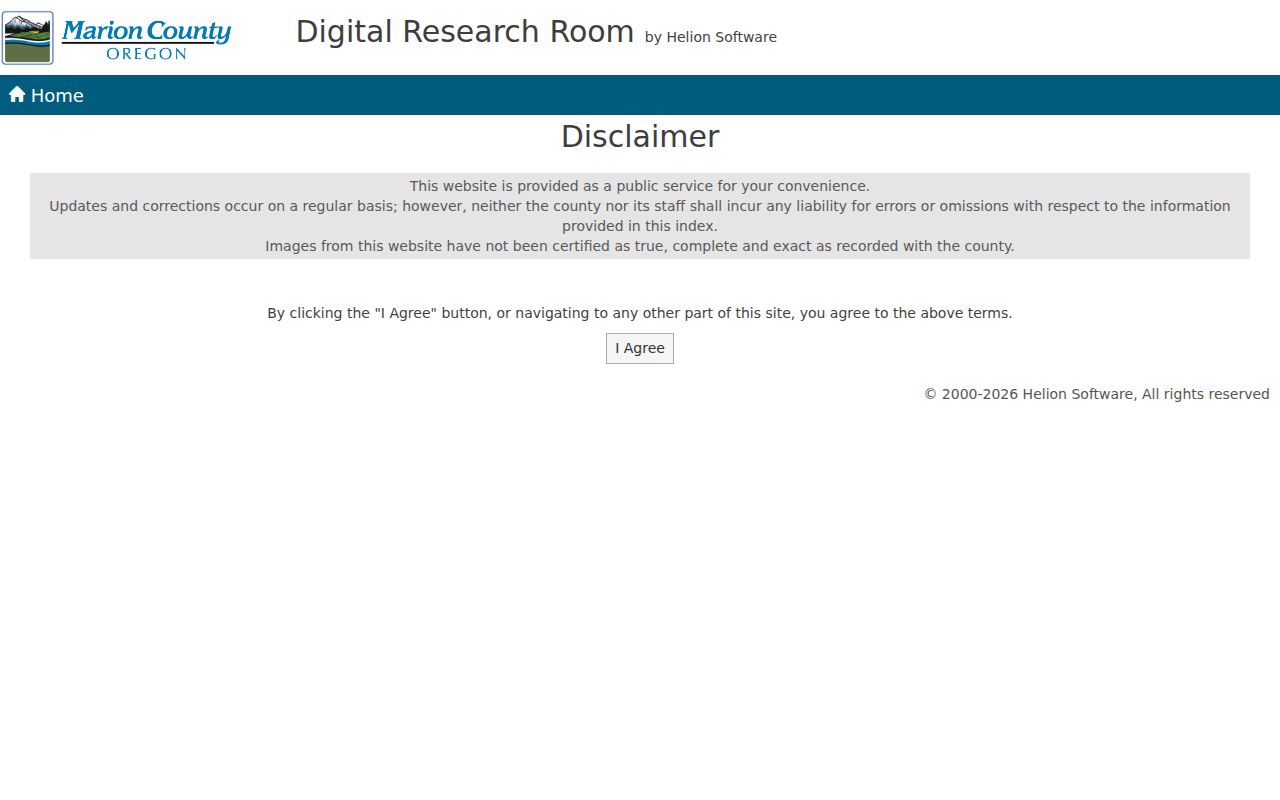
Marion County keeps two overlapping recorded-document paths. The Digital Research Room is the county route for modern documents from 1974 forward. It is a public index and image service, but its images are not certified copies. The county historical deed search is labeled 1855 through 1976 on the records page, while the live form says 1850 through 1976. Preserve the date source when using either label.
The modern research-room entry screen shows the county's public-service notice before a document search begins.
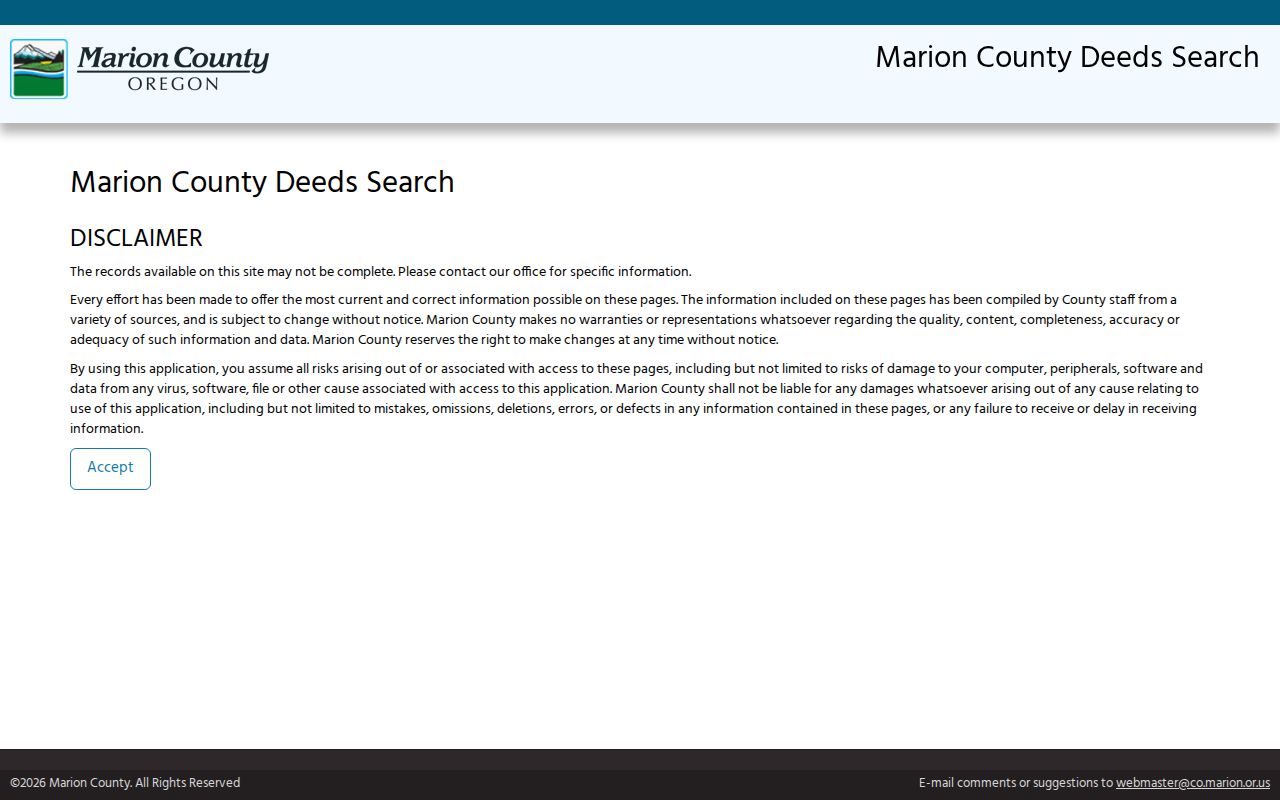
For an older transaction, the Historical Deeds Search uses direct party, or grantor, and indirect party, or grantee, with dates and instrument type. It is not an address search. An owner name, tax lot, legal description, or recording chronology should guide the party search. When the online image matters, request the record from the Clerk.
The county historical deed index exposes its party and date search controls for the earlier-record path.
The index is most reliable when a legal description and party role travel with the result. The period overlap gives a 1974 to 1976 transaction a useful opportunity for cross-checking, not two separate transactions.
Current Marion County Resident Sources
Current Marion County resident evidence is divided by custodian and record purpose. The property roll has an owner tax-account name and situs. A recorded-document index identifies parties to a transaction. Court data can identify a party to a public case. Oregon voter records have a defined statutory release process and exclusions. No row below should be read as a broad claim about everyone at an address.
| Record source | What it can establish | Custodian | Access route |
|---|---|---|---|
| Property tax account | Situs, tax lot, owner-name result, mailing-field context | Marion County Assessor | Free Property Search and parcel viewer |
| Recorded documents | Named parties and dated property instruments | Marion County Clerk | Modern research room or historical deed index |
| Public court record | Party, case, events, and disposition where public | Oregon Judicial Department | Free basic search, subscription, terminal, or request |
| Voter registration record | Permitted elector fields and civic status | County Elections and Oregon Secretary of State | Self-service or statutory list request |
| Historical archive material | Dated census, probate, assessment, tax, and related evidence | Oregon State Archives | Database, appointment, microfilm, or reference inquiry |
For one named individual, use a separate-record process to test distinct sources without converting one partial hit into a profile. Important source fields include the source date, jurisdiction, party role, and the difference between a physical address and a mailing field.
Marion County Voter Records and Protection
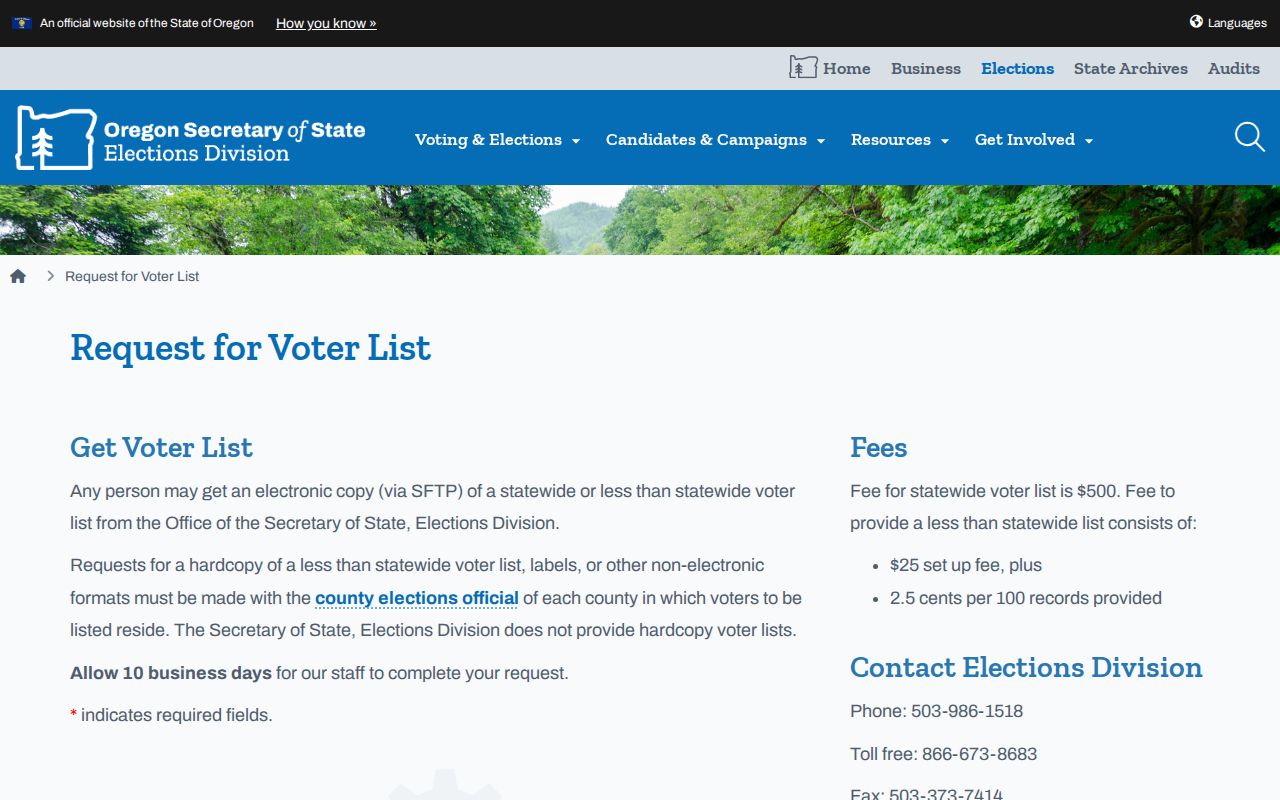
Oregon My Vote is for a voter to check or update that person's own registration. It is not a public browse-by-address directory. The Secretary of State can provide an electronic statewide or less-than-statewide voter list through SFTP. The state lists a $500 statewide charge, or $25 setup plus 2.5 cents per 100 records for a less-than-statewide electronic list, with a stated 10-business-day estimate. Hardcopy and label formats go to the county elections official.
Oregon's voter-list request page distinguishes those statewide and smaller-area electronic request options.
ORS 247.945 and ORS 247.948 set the boundary. The list can include defined registration information, including year of birth and precinct data when not otherwise protected. It does not reveal ballot choices, full dates of birth, signatures, Social Security numbers, or driver license numbers. Safe at Home participants and other protected information remain excluded.
Respect protected records. Do not use a voter, property, court, or archive result to pursue a protected location or to harass anyone. Oregon's Safe at Home program exists to protect eligible survivors through a substitute address.
Marion County Court and Vital Checks
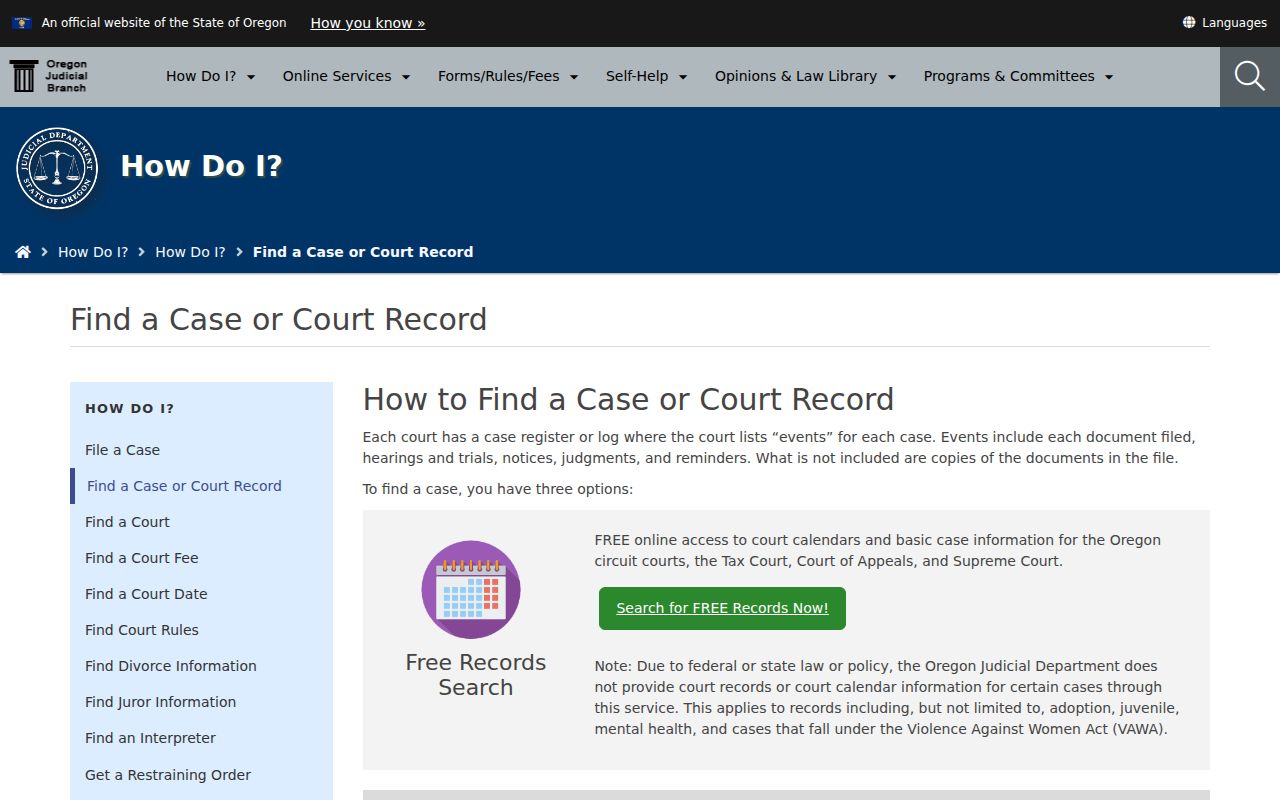
The Oregon Judicial Department Records and Calendar Search supplies basic public case information, party information, events, and dispositions. It is not the official register and does not expose confidential categories. Deeper OJCIN access is a registered, low-cost subscription. Marion Circuit Court also maintains six free public terminals, available from 8 a.m. to noon and 1 to 5 p.m. on weekdays. Known documents can be requested by case number and exact document or hearing date.
The state court search information page explains the basic public search route and its different access levels.
Vital records follow a separate state rule. Oregon birth records are restricted for 100 years. Death, marriage, divorce, domestic-partnership, dissolution, and fetal-death records are restricted for 50 years. Oregon Health Authority ordering guidance identifies the official eligibility and order routes for current certificates; the State Archives is the route for qualifying historic records.
Marion County Requests for Existing Records
The Marion County public-records request procedure is the fallback when an identifiable existing county record is not available through a portal. Name the department, record type, date range, and any address, parcel, account, instrument, or case detail that will let staff find it. Ask for inspection or copies. The Oregon Public Records Law concerns existing records; it does not require a county department to assemble a custom chronological resident list.
The county request page presents its written process, calendar, and fee information.
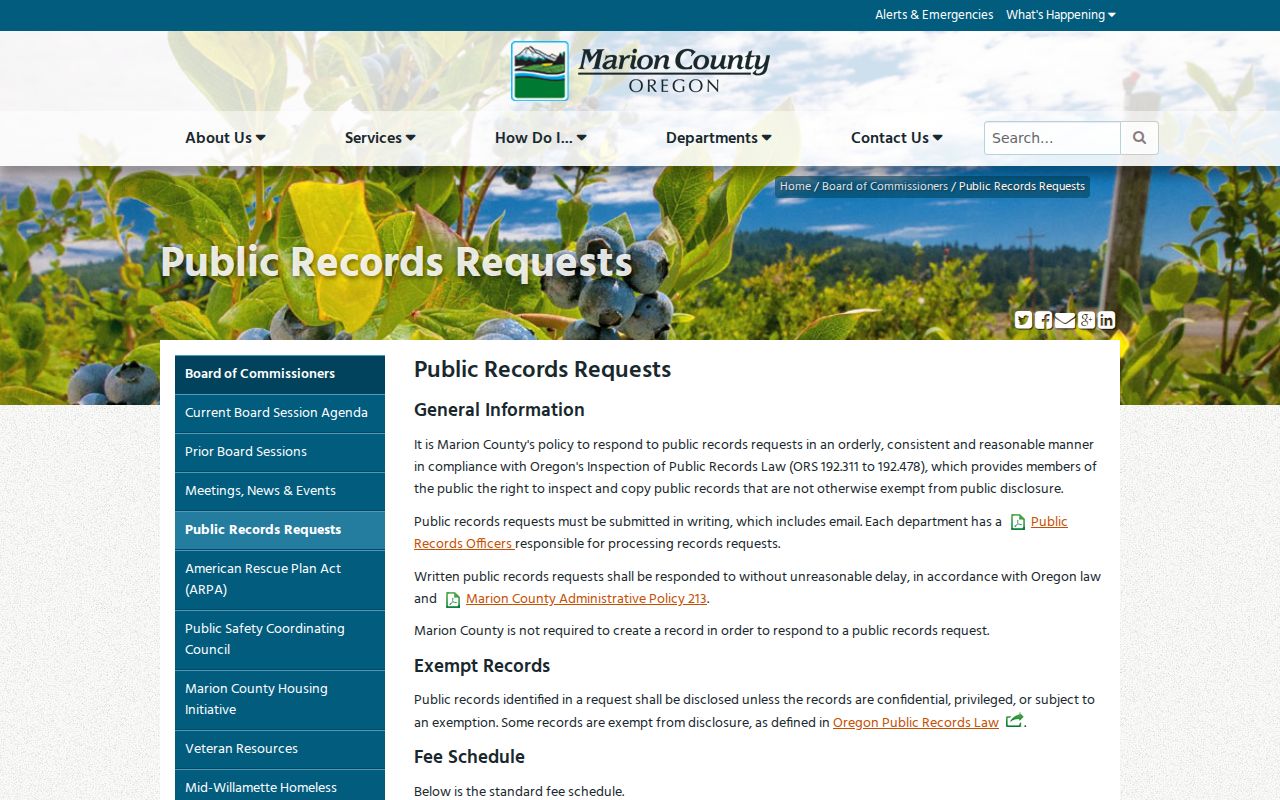
Marion County ordinarily acknowledges a request within five business days, then completes it or gives a written processing or estimated-completion response within 15 business days. Its stated standard costs include 25 cents per photocopy, $10 for a flash drive, $1 for a CD or DVD, actual postage, and burdened staff time. An estimate or deposit can apply.
Marion County Historical Directory Trails
Historic local research is layered, not a seamless online shelf. The City of Salem's historic-property research guidance says a person's name is needed to use a city directory effectively before 1932. A deed, tax roll, probate file, census item, newspaper notice, or map can provide that starting name. Then compare a directory year with an address and keep the source date visible.
The Salem Public Library online-resources page, Oregon State Library reference staff, and the State Archives are the honest routes for checking which volume or microfilm run is available. A criss-cross directory can be useful once a verified volume is found, but no complete official publisher-by-publisher Marion County run was captured in the research. The deeper collection method belongs with the Marion County city directory material.
Marion County Before Its Current Name
Marion County was created in 1843 as Champooick, also spelled Champoeg, and was renamed Marion in 1849. Salem became the county seat that year. The State Archives notes later boundary changes, including the 1847 division that created Linn County and the current boundary established in 1854. Those dates change which county term may be the best catalog search.
The Early Oregonians database is a focused way to test early name variants. It covers people associated with Oregon from 1800 to 1860 and allows a Marion or historic Champoeg county selection, a date range, and a first or last name. A wildcard works with at least two other characters. Results lead to Person Profiles with associated-record and federal-census tabs, but blank profile fields are not negative proof.
The State Archives Marion County guide displays the local early-record trail that sits behind archival research.
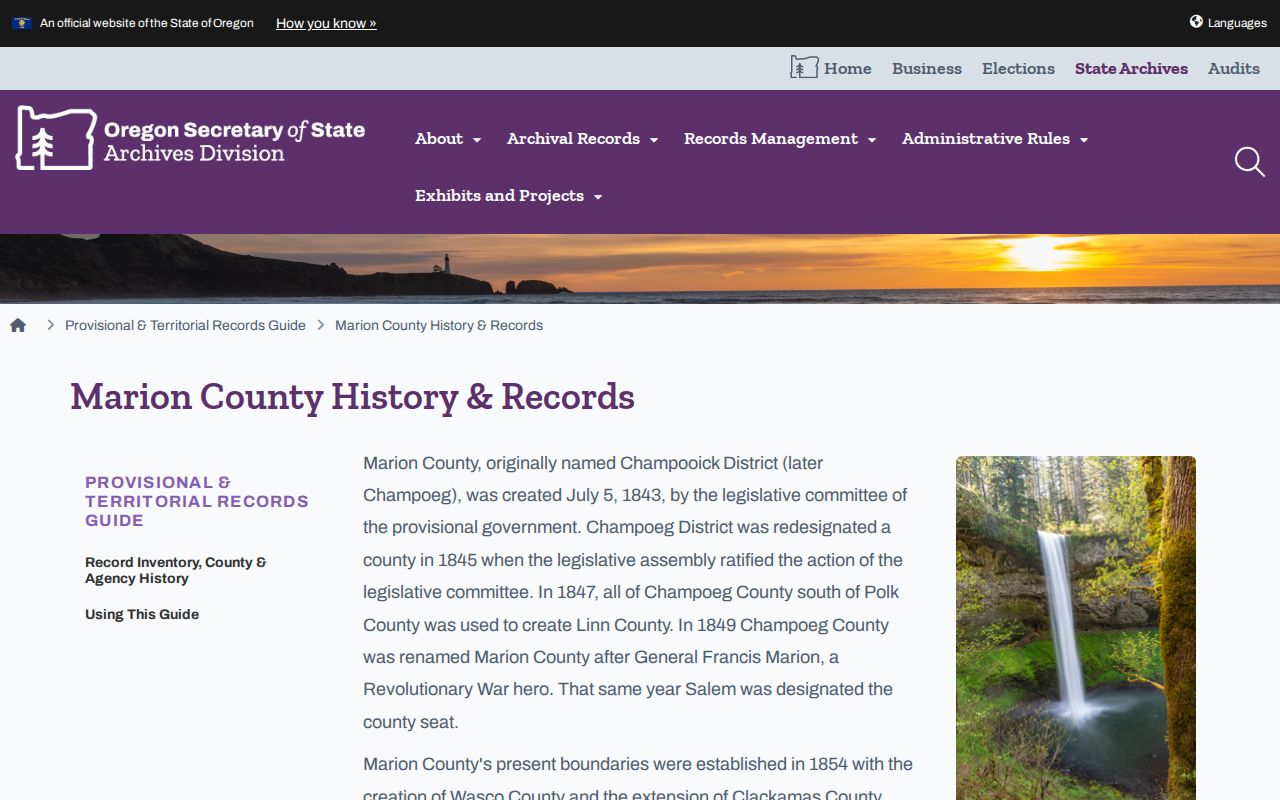
Assessment rolls from 1854 to 1859, county census rolls from 1849 to 1857, clerk registers from 1850 to 1859, probate, tax, naturalization, and will materials can all provide period evidence. They describe a past record event, not a current location.
Marion County Results Need Boundaries
Commercial people-finder products may combine public and other data, but their matches can be stale or misattributed. An official roll has a known custodian, date, and stated limits. It may take longer to use, yet it is the better place to test a real question. A court docket is a chronology, not a biography. A property owner field is not an occupant roster. A voter record does not reveal ballot choices.
| Research route | Strength | Limit to retain |
|---|---|---|
| Official county or state record | Named custodian and defined record purpose | Coverage, access, and confidential-data rules still apply |
| Historic archive source | Dated primary or indexed evidence | Shows a past source event, not a present identity |
| Private compiled directory category | May suggest a lead to verify | May combine stale or mismatched data and is not a custodian record |
Start at the official source, keep only the details needed to distinguish a same-name record, and contact the custodian for a certified copy or correction route when the fact matters.
Marion County Registration Is Self-Service
The official Oregon My Vote entry takes a voter to a secure self-service process for registration information, updates, ballot and drop-site information, and the county elections office. The secure endpoint presented an anti-automation challenge during research, so no unverified field labels belong in a Marion County residents directory. A voter can also contact Marion County Elections for status or process information.
The Oregon My Vote entry page is the official starting point for that personal registration service.
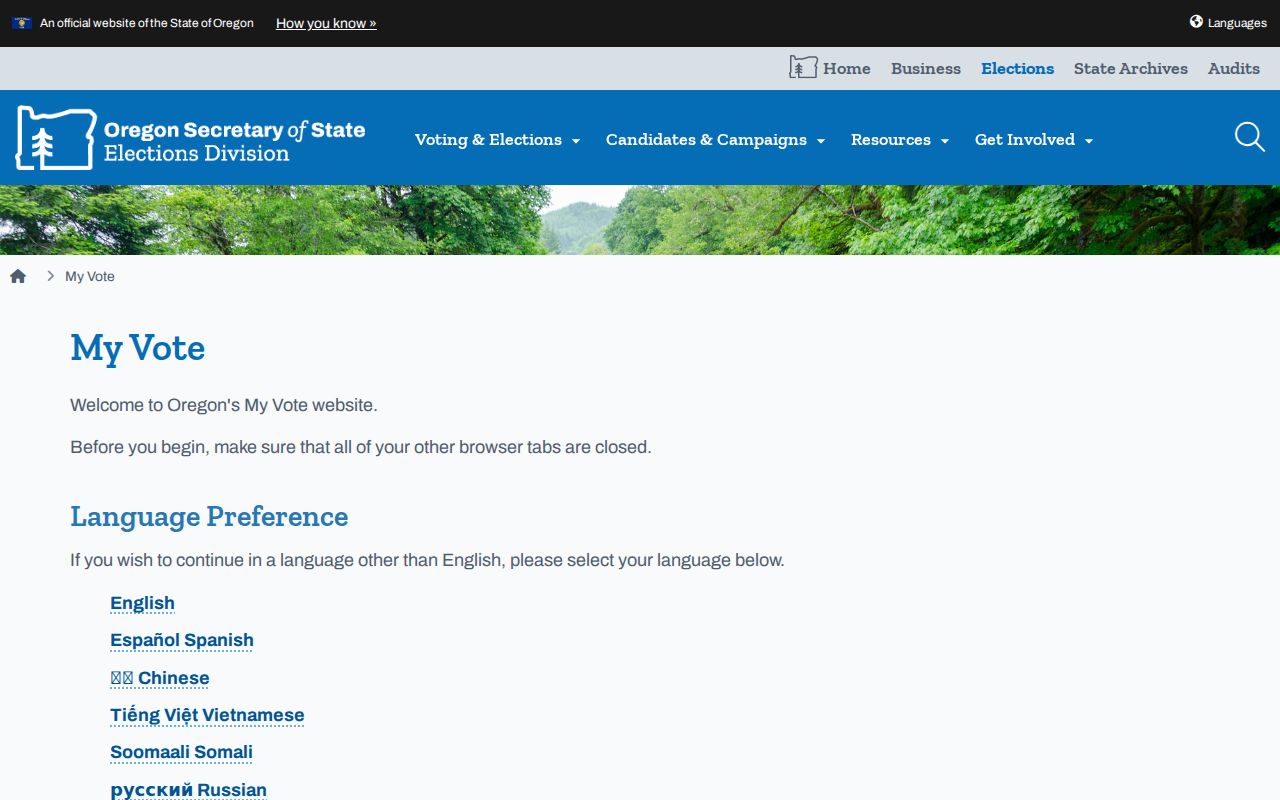
The page's secure nature is a feature, not a gap to bypass. Use a county or state list request only when the statutory route fits the question and the protected-data limits can be respected.