
Marion County Previous Residents by Era
A backward search changes source when its date changes. The assessor and parcel viewer describe the current tax account and its instrument clues. The Clerk’s modern and historical indexes can then move the property trail backward. Older household work relies on archives, census records, and a verified directory volume. The table keeps property ownership, address context, and household evidence distinct, which matters when researching who lived here before rather than only who held title.
| Source | Years it covers | Where held | What it shows |
|---|---|---|---|
| Assessor and parcel viewer | Present tax roll, refreshed daily | Marion County Assessor and GIS | Situs, tax lot, owner mailing field, legal and instrument bridge |
| Digital Research Room | 1974-present | Marion County Clerk | Modern recorded instruments and uncertified image leads |
| Historic Deeds Search | Live form: 1850-1976; county label: 1855-1976 | Marion County historic portal | Grantor, grantee, date, and instrument index trail |
| Clerk register and early rolls | Register 1850-1859; assessments 1854-1859; tax 1852-1853; census 1849-1857 | Oregon State Archives microfilm and inventory | Early parties, property, taxpayer, and local population evidence |
| Federal census and verified directories | Latest open federal census is 1950 in 2026 | National Archives access; City and library reference routes | Household context at a dated point, not continuous occupancy |
| Building permits | Online individual-permit starting point after February 1995 | County ePermitting or records request where covered | Work and inspection chronology, not a resident roster |
The first choice depends on the question. A current street address belongs in the assessor search. A known sale or instrument belongs in the Clerk indexes. A territorial question may need a State Archives appointment or reference inquiry. An online miss can mean an undigitized record, a variant party name, a different jurisdiction, a sealed record, or no record at all. It never proves that a past household did not exist.
Marion County Address Record Trail
Begin the Marion County address trail with the Assessor Property Search. Its documented choices are Account Number, Map Tax Lot, Situs Address, and Subdivision, not a direct owner-name category. A result gives an account number, owner name, map tax lot, and situs address. Preserve the tax lot, plat, block, lot, legal description, owner tax-account name, and any sale or instrument fields before moving to another source. The property system is updated every 24 hours, but a tax-account owner field is not a list of occupants.
The Property Records Viewer can confirm the parcel polygon and exposes useful bridge fields, including instrument number, type, date, sale price, owner mailing, and situs. Keep mailing and situs fields separate. A situs is the physical property location. An owner mailing value is where a tax account receives mail, and it can refer to an entity, an estate, or a person elsewhere.
Open the Digital Research Room for the modern recorded-document route.
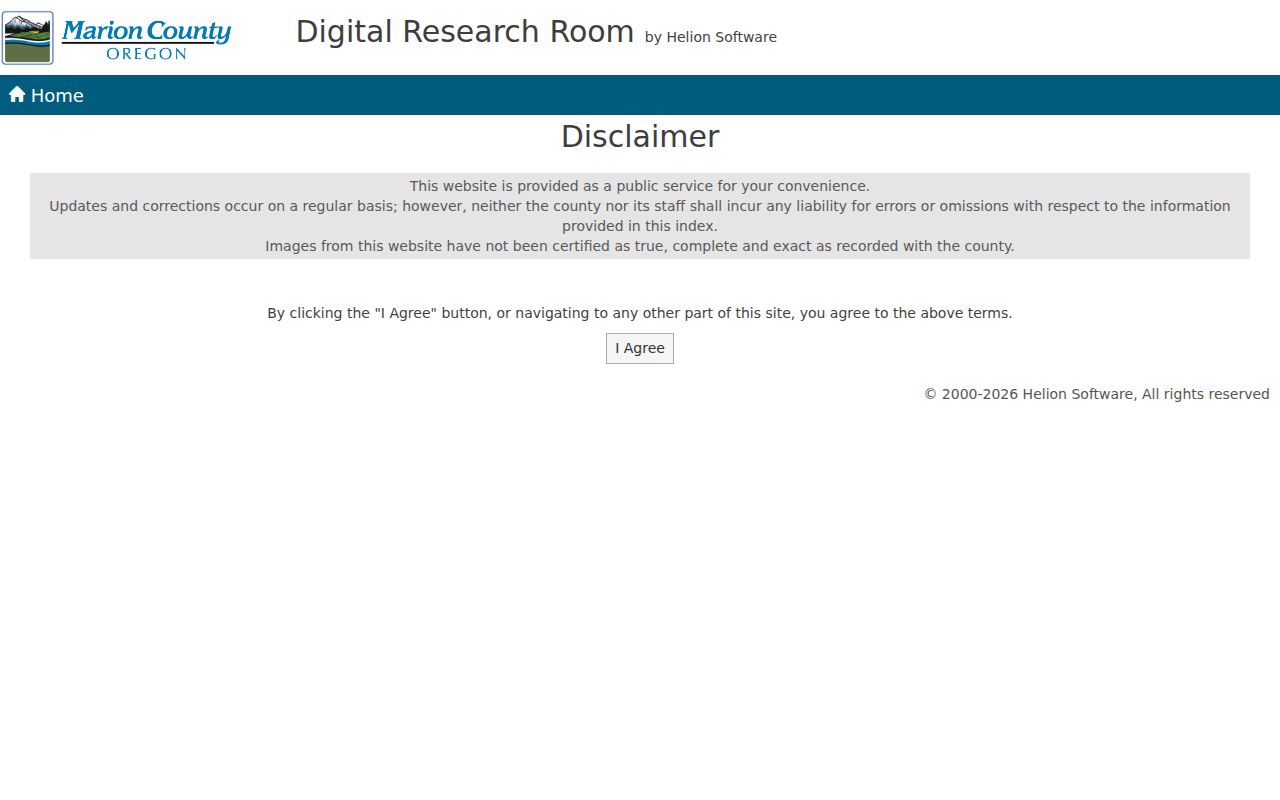
The modern system is a document lead, not a certified copy. Its public-service disclaimer says updates and corrections occur, and its online images are not certified true, complete, and exact records.
For a legible or certified instrument, contact Marion County Licensing and Recording. The recording counter is at 555 Court Street NE, Suite 2130, Salem, Oregon 97301; the recording line is 503-588-5225, and the office lists recording@co.marion.or.us. Those counter, phone, email, and official-copy channels matter when a modern index result needs verification.
Marion County Deed Record Chain
The historic deed route is party and date based, not a past street-address search. It has File Date Start and End fields in MM/DD/YYYY format, an instrument menu, Direct Party for Grantor, and Indirect Party for Grantee. The index directs a user to begin party searches with only the first letter. Its options include deed direct and indirect, mortgage direct and indirect, miscellaneous, and oil and gas entries. Carry the tax lot and legal description into every result review.
The historic deed index shows the Marion County search fields used for an earlier title trail.
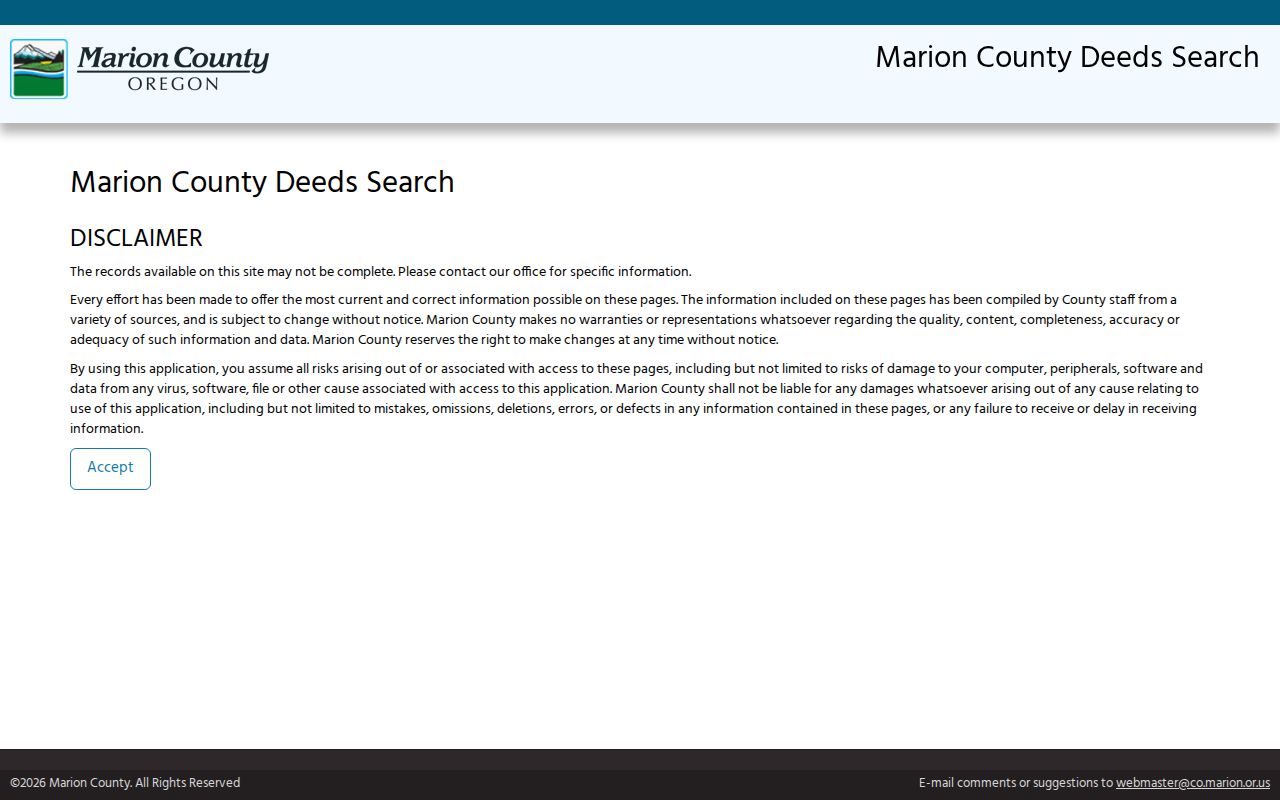
The first-letter instruction and party fields show why a legal description and instrument chronology are more reliable than an old house number alone.
- Search the present situs in the assessor system and copy the tax lot, plat, block, lot, legal description, current owner tax-account name, and any instrument number, type, or date.
- Use the current recorded-document index for a 1974-or-later instrument, then read the recorded parties and property description.
- Identify the seller in that conveyance and search that person as a prior grantee or indirect party to find the earlier acquisition of the same property.
- Repeat the party switch while checking the tax lot and legal description at each link. Do not accept a surname or street name match by itself.
- Cross-check transactions from 1974 through 1976 in both systems when available, then use the State Archives register for the 1850-1859 early-record period.
The overlap is a valuable check, not duplicate ownership evidence. County navigation labels historic deeds 1855-1976, while the live form says 1850-1976. Record both labels and request a Clerk copy when a document must be relied on as an official record.
Marion County Deed Record Terms
Old instruments can use familiar words in a precise way. Write the term beside the source date and preserve the original spelling. That practice makes it easier to compare a deed index, a parcel layer, and an archival register without forcing them into a modern address format.
- Grantor
- The party transferring an interest in an instrument. In the historic deed search, this is the direct-party field.
- Grantee
- The party receiving an interest. In the historic index, this is the indirect-party field and can lead to that party’s prior acquisition.
- Chain of title
- The dated sequence of recorded transfers and related instruments for the same property interest, tested link by link.
- Legal description
- The recorded parcel description, such as a tax lot, plat, block, and lot reference. It often remains more stable than a street address.
Note: A parcel map is useful context, but Marion County does not present its Internet Mapper as a legally recorded survey.
Previous Residents and Directory Dates
Past residents can be missed when a researcher searches only a present street number. Road names, numbering, unit designations, parcel splits, annexation, rural-route descriptions, and postal conventions can change the way a place appears. Marion County’s records work better when each older reference is paired with the tax lot, plat, block, lot, township/range, or legal description that survives the change. The address itself is an entry point, not the proof of continuity.
For Salem property history, the City historic-property guide recommends starting with the ownership chain, addition, lot, and block. It then directs researchers to Sanborn Fire Insurance Maps and city directories. Before 1932, the City warns that a person’s name is needed to use a directory effectively. Ask the City or Oregon State Library which Sanborn years cover a specific address; no verified Marion or Salem annual holdings run supports a more precise claim.
Directories can add dated household context after the property and person are identified. The collections and their documented limits are summarized on the Marion County city directory resource. No verified countywide online criss-cross catalogue was located, so do not assume a reverse-address section exists for a particular year.
Marion County Census Records Pairing
Household evidence answers a different question from a deed. A federal census can name people and relationships at a stated enumeration date, but it does not fill every intervening directory year. The latest open federal population census is 1950 in 2026. Pair a directory year before or after 1950 with that census where the dates and address support it. For a directory from 1940 or earlier, compare the matching released census rather than inferring continuous presence.
Early local rolls give a second time band. The State Archives inventory lists county census records for 1849-1857 and assessment rolls for 1854-1859. Tax rolls cover 1852-1853. These sources can place a person in a county, tax, or population context, but they are not a modern house-number index. A dated obituary, probate file, or historic marriage lead can help test an endpoint before returning to the property chain.
Note: Match the date, jurisdiction, spelling, and source reference before treating a census name as the person in a property record.
Marion County Permit Record Limits
Permits supply a work-history layer, not a list of previous residents. Marion County Building Inspection covers unincorporated areas and cities without their own inspection program. Its ePermitting information identifies individual permits after February 1995 as the online starting point and cautions that not all records appear online. First determine whether the address is in the county program or a municipal program. Then use the street address, permit number, or approximate work date to locate an existing record or make a narrow county public-records request.
The Building Inspection office is at 5155 Silverton Road NE, Salem, Oregon 97305, with 503-588-5147 and Building@co.marion.or.us listed for contact. A permit may show an application, work type, or inspection date. It does not prove who occupied the property, whether all work was permitted, or the current condition of a structure.
Marion County Archive Record Endpoints
When the online property trail reaches its early limit, use the State Archives Marion County guide to choose a record type. It identifies the Clerk recorded-documents register for 1850-1859, probate and naturalization material, tax and assessment rolls, court records, and wills. The Archives research room at 800 Summer Street NE in Salem is open by appointment, and the reference number is 503-373-0701. The statewide Historic County Records Guide helps when the local inventory points to another repository.
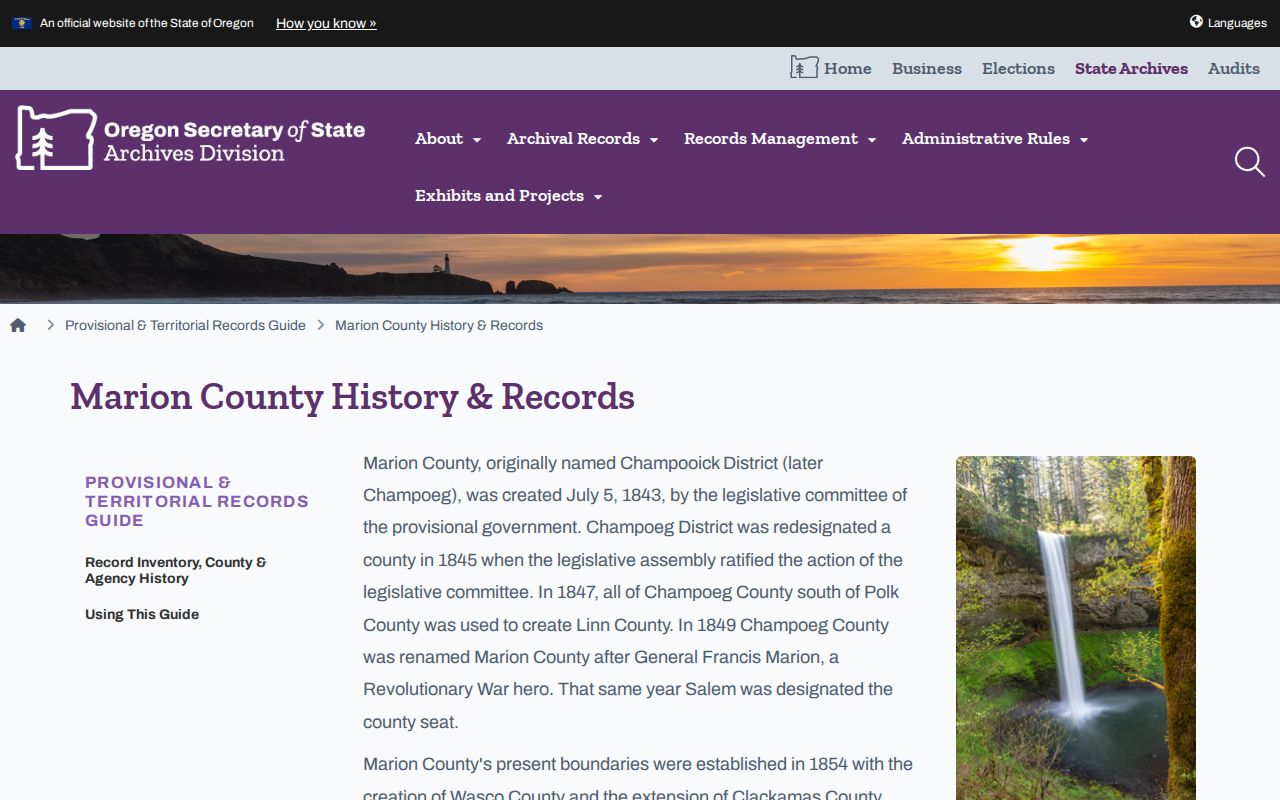
The archival inventory is the bridge from a deed-chain gap to a dated clerk, tax, census, probate, or court source.
The county’s Records and Archives page also links historic deeds, marriage licenses from 1849-1977, Commissioners Court Journal material, and board records. Use a marriage result as a lead to the event record, not as proof of a person’s address or a substitute for a vital-record process.
Respecting Previous Residents
House-history research belongs to a defined personal, family, archival, estate, or property question. Keep only the details needed to tell one record from another. Public availability does not justify compiling sensitive details, tracking a living person, or trying to work around a protected address. Oregon’s public-records law provides a route for requesting existing identifiable records; it does not require a custodian to create a new personal compilation.
Lawful use. Use Marion County records about past residents for careful history and documented property questions. Do not use an old address trail to harass, intimidate, repeatedly contact, or locate a protected person.
Safe at Home participants and other protected voter information are excluded from ordinary voter-list access. For a safety concern, use the Oregon Safe at Home program or the relevant custodian. Oregon laws against stalking and harassment remain in force when information comes from a public source.